Labels

Showing posts with label Navigation. Show all posts

Tuesday, May 29, 2012

TomTom releases its latest map update for the summer jurneys


Tomtom has just released  new maps in preparation for the Summer. In total, 1.5 million km of new roads have been added to TomTom’s global map between May 2011 and May 2012. Additionally, new stadiums, temporary and permanent event venues and park & rides across the UK, Poland and the Ukraine have been included. Major map changes include adding 107,000 km of new road networks in Brazil, and updating 12,000 km of motorways in Spain.

Maps have been extended to cover greater areas of Mexico, Malaysia and Indonesia. Southern Africa maps now include more unpaved roads in rural areas for better routing and more accurate estimated times of arrival.

In addition, TomTom announced the TomTom Via 130, featuring a new Speak & Go function where drivers can control the device with just the sound of their voice, as well as making hands-free calls, which helps them keep their hands on the wheel and their focus on the road.

source: TomTom

Saturday, May 26, 2012

Bing Maps now uses live traffic and geocoding from Nokia

Apparently the collaboration of Microsoft and Nokia goes beyond Lumia smartphones. After the latest up-date the  - now uses Nokia's live traffic and geocoding algorithms. Bing Maps can now offer the same traffic information that is already available at Nokia Maps in 24 countries (Austria, Belgium, Brazil, Canada, Denmark, Finland, France, Germany, Greece, India, Indonesia, Ireland, Italy, Luxembourg, Mexico, Netherlands, Norway, Poland, Portugal, Russia, Saudi Arabia, South Africa, Spain, Sweden, Switzerland, UAE, UK and US).

Why is it a good news?

This info is really important for all Bing Maps users from one basic reason - Nokia is the owner of Navteq - the biggest mapping data player on the planet. Not only their traffic data is one of the most accurate but also their geocoding algorithms (taking latitude and longitude information and connecting that to a readable address) will surely offer better routes and directions for Microsoft-mapping service users.

But this not the most important conclusion... the most important thing is that those two giants are teaming up to build better location-based services and apps. With their financial potential and Nokia's announcement of the new  Nokia’s Where Platform, can bring LBS to whole new level. I'm looking forward to see where it will go!!!

Nokia Where Platform video:


Tuesday, May 22, 2012

New Inrix Traffic 4 - helps drivers avoid traffic congestion for free

When you live in US (and recently Europe;) and you check your morning traffic info you don't really think about where is this data coming from... Well there is big chance that it's coming from Inrix that is the leading-provider of traffic information, directions and driver services all over the world. The company that is usually behind the scenes of the biggest players including huge number of the hottest automotive brands  is now coming out. 

The company collects and analyzes traffic data points from nearly 100 million sources, and now it's putting that information to work with Inrix Traffic 4 for iOS. In addition to helping users avoid congestion brought on by road work, police activity, local events and traffic accidents, the app now provides drivers with optimal routes. 

This surely not the best navi app ever but it's for free and with the best traffic information available on the market, so it's definitely worth trying. 


source: Engaget, Inrixtraffic

Friday, October 21, 2011

TomTom HD Traffic in Czech Republic - is the service entering Central and Eastern Europe?

Yesterday TomTom announced that it will launch TomTom HD Traffic service in Czech Republic. It will enable drivers to take the fastest route to their destination based on the most accurate and real time traffic information. Including Czech Republic TomTom HD Traffic will be available in 23 countries. TomTom claims that with 80 million probes (cellular and GPS) worldwide its HD Traffic service covers 99.9% of the road network, covering traffic jams on main roads as well as secondary and local roads.

Let's hope that this means expansion of HD Traffic service to Central and Eastern Europe (I'm looking forward to welcome this service in Poland :). However the market of retail PNDs is already very saturated in this region, the service is targeted as well to B2B clients with WORKsmart™ fleet management solution. In fact two days ago TomTom won 2011 GreenFleet Awards in IT Innovation category for its 'Eco system', which gives fleet managers the tools to promote and monitor eco-friendly driver behaviour, reduce fuel consumption and carbon emission = decrease costs. The system is actually based on a traffic data, therefore HD Traffic service expansion could mean one step further in the leadership in B2B fleet management solutions as well in this part of Europe. 

source: TomTom 

Thursday, October 06, 2011

TomTom - Go Live 1535M - Social media in your satnav - is it really needed?

Announced on  Aug 29th 2011, TomTom's Go Live 1535M now expands to Canada.This model offers you dashboard tweeting and access to Yelp's recommendations. There are several useful things in there: first of all HD Traffic that is already working in 22 countries and users love it. There are Fuel Prices that help you to locate the lowest priced fuel on your route or in your area. There is Trip Advisor and Expedia to help you find and book a hotel, finally there is even a Google Local Search. 

Is it really needed?

There is one major question that comes to my mind when I look at this functionality: 


Why the hell would I use twitter and yelp while driving a car? 

When I want to use apps like this I stop my car and use my smartphone. But... there are couple of answers to that question:
  • First of all, primo, you often go somewhere with passengers, so they might use it...
  • Second of all, who is TomTom's target customer group for this product? According to the latest 2011 PEW Report 35% of adult Americans own a smartphone and according to Nielsen 74.6% of users of Android and I guess similar number of users of iPhones uses Google Maps (not counting in other navigation products) to get from place to place. This is clearly not a target customer group to TomTom but the rest of 65% of adult Americans are (!!!) and for them access to services like Yelp might be really useful.
  • Finally it's quite an innovative product within the Personal Navigation Devices market, isn't it? TomTom known as the leader of the industry is proving its strength. They are as well getting some know-how in such a LBS solutions and probably soon you'll be able to share with friends on Facebook in a that you are stuck in a traffic jam while going to them, without being accused of lying.  

Who knos, maybe soon similar solutions will be available in build-in car navigation systems. But there is one problem Go Live 1535M is using GPRS connections to get data from the internet and it is already being phased out in some parts of US. The idea is cool. Let's hope that it's going to evolve in the right direction.

source: TomTom

Friday, July 15, 2011

Nokia Web OVI Maps optimized for iPhone and Android.

After acquiring Navteq in 2007 Nokia seriously disturbed GPS Navigation industry. With free Nokia maps and its dominance on the market many analysts foreseen the death of the paid navigation. At that time I was working for one of the local European car navigation producers and the management was seriously concerned about the future of the company.  Then Nokia missed smartphone revolution and competitors (including Google Maps) made many improvements to their navigation apps. I always had a feeling that Nokia is not fully utilizing potential of Navteq (acquired for $8.1 billion). Although Navteq is the biggest geographic data producer in the world, Ovi Maps could never successfully force it's way through competition. 

Nokia Ovi Maps - version 3.8

The Nokia Beta Labs has just released version 3.8 of Nokia Ovi Maps. Apart from several improvements in home-screen and functionality the most important information is that Nokia Labs optimized a beta Web version of Nokia Maps for Android and iPhone. You just need to go to: m.maps.ovi.com with your smartphone to access the web app that allows for basic navigation functions like calculating routes and location your position on the map. Currently  “turn by turn” navigation and voice directions are not yet available. 

Competing on iPhone and Android market?

Obviously this functionality is not enough to compete on the smartphone navigation market but it's a good step forward. Nokia has enough resources to create great navigation product for all major platforms. Probably it's contradictory with company's business strategy but as we could observe during last couple of months Nokia's strategy was not very consistent. As I have a sentiment to Nokia (I still think that Nokia 3310 was one of the best phones ever) I would really like to see them disturbing this time smart phones navigation market.


source: Nokia

Tuesday, June 28, 2011

TomTom's iPhone App update to version 1.8 with Multi-Stop routes

There was a new update to TomTom's iPhone App released yesterday. Version 1.8 was complement with new Multi-Stop Routes functionality. It means that you can add up-to five extra points to your route without recalculating it, so you can for example pick up friends and visit places of interest more easily – and you only need to plan your route once. 

Many bloggers (including Engadget) wrote that with this update TomTom releases HD Traffic data to iPhone. Dear bloggers TomTom HD Traffic service is available in the AppStore at least from March 2010!!!

After acquiring TeleAtlas - one the world biggest producers of geographic data - TomTom became undeniable leader on the GPS Navigation market. With it's innovative products TomTom's mission "to reduce traffic congestion for all" becomes possible.  

source: TomTom

Wednesday, June 15, 2011

C3 Technologies - Google Earth killer?


C3 Technologies - company with its origin in the Swedish aerospace and defense company Saab AB, is now applying previously classified, military image processing technology to the development of 3D maps as a platform for new social and commercial applications. And the effect is astonishing especially knowing that according to the company its generated automatically. It is a very promising 3D data capturing and visualization solution for the navigation and geographic information systems industries.

How do they do that? 

C3 maps are assembled almost automatically using high resolution, spatial areal imaginary. So basically their planes are outfitted with photogrammetric cameras pointing every direction and capturing overlapping images. Knowing the GPS position, angles, rotation and distance between cameras their are able to almost automatically generate 3D, photo realistic, stereo-graphic view on a captured area.


Previously similar data could be captured by LiDAR - remote sensing technology that uses laser scanning to collect height or elevation data. LiDAR is however pretty expensive technology. We don't know the initial costs of the C3 technology but it seems very cost effective in use. Google Earth from the other side involves using Google SketchUp 3D modeling. That means that people are almost manually putting parts of maps together which is is very time ineffective. 

Nokia OVI Maps 3D 

C3 Technologies has partnered Nokia to deliver the first usable version of its mapping data with Ovi Maps 3D in the begging of 2011. Currently it features 20 cities with limited functionality: pan, zoom, changing view angle. Company claims however to have 100 city models already produced with 22 more scheduled for Spring 2011. With this functionality its just a gadget to play and to check the possibilities of C3 technology. But does it mean that Nokia will use this data in OVI Maps? I am looking forward to here something about it.  

Google Earth killer?

Definitely not yet. The potential of Google Maps and Google Earth is not rooted in 3D view but in data that they have collected and interoperability with open standards (like KML). Row 3D without data about roads, streets, POIs ect. is not very useful.

But let's concentrate on 3D view itself and compare two products: Google Earth and Nokia Ovi Maps 3D. I order to do that I decided to choose Sagrada Família, one of the most architecturally sophisticated church in the world, situated in Barcelona, Spain, designed by Catalan architect Antoni Gaudí in early XX century.


We can observe that C3 model is much more photo realistic. Shadows and amount of details is really impressive. We can see however that automatically generated 3D geometrical objects like towers or rooftops of building on the second plan are not perfectly represented and Google Earth has advantage in this field. There is as well difference is representation of trees and ground details between two models. In Google Earth they are flat and in C3 they are convex, however not really well represented. 

I'm looking forward to see some more commercial applications of C3 3D maps and how they will develop. Both Google Earth and C3 models have their pros and cons. Maybe in a future we  will witness fusion of both technologies.


source:  C3 Techologies, Nokia OVI Maps 3D

Garmin to acquire Navigon

On Tuesday 14th of June, 2011 Garmin - one of the most popular sellers of navigation and smartphone GPS software - announced that Navigon’s shareholders have signed an agreement for a Garmin subsidiary to purchase Germany-based Navigon. “This acquisition is a great complement to Garmin’s existing automotive and mobile business. Navigon has invested significantly in the European automotive OEM business, and we feel that we can rapidly expand our automotive OEM footprint and capabilities through this transaction,” said Cliff Pemble, Garmin’s president and COO. “With Navigon, we are also acquiring one of the top-selling navigation applications for the iPhone and Android platforms – something that we expect will help drive revenue for the combined company going forward. Combining Navigon’s and Garmin’s strength also improves our competitiveness and standing particularly in Europe.” Garmin said that Navigon will continue to operate as a subsidiary of Garmin and that the deal is still subject to regulatory approvals. 
A Garmin spokeswoman at the company’s Olathe headquarters declined to reveal what the company paid for Navigon, which is 90 percent owned by General Atlantic Partners, a private U.S. equity firm. Financial Times Deutschland reported this month that Garmin was considering paying more than $70 million.
Some analysts saw Navigon as a struggling company with just 5 percent to 7 percent of the European market. (It holds about 20 percent of the market in Germany.) By purchasing the company, Garmin perhaps saves Navigon and adds incrementally to its own sales in Europe. Garmin also was enticed by Navigon’s popular applications for iPhone and Android smartphones.
Garmin, Navigon and Dutch manufacturer TomTom, the European leader, have all seen their prospects hurt by the smartphone. Many consumers are forgoing purchases of handheld GPS devices and relying on applications in their phones instead. That has meant a shrinking market for GPS device makers, which have begun to battle for contracts to provide the devices built into the dashboards of cars and trucks. Garmin also has found rich markets in devices made for boaters, bicyclists and people looking to incorporate navigation into their athletic training regimens.
Navigon was founded in 1991, two years after Garmin. The German company’s first signature software product debuted in 1996 as Autopilot, later named AutoPilot 2000. The company continued as chiefly a maker of software until 2008, when it began to sell its own navigation devices. But the timing proved poor with the spread of navigation-enabled smartphones, and Navigon quickly pulled its devices from the U.S. market. Worldwide, Navigon has more than 400 employees. Garmin has about 7,000 workers and more than half the American GPS market. TomTom, its chief competitor, has just less than half the European market and a fourth of U.S. sales.
source: Engadet, The Kansas City Star

Saturday, May 28, 2011

AIDA 2.0 – 3D, Interactive Dashboard Car Navigation

AIDA 1.0
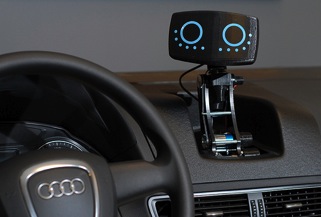
In 2009, MIT and Audi researchers created AIDA, which stands for Affective Intelligent Driving Agent. The first generation of the project produced a somewhat creepy and 'very friendly'  in-car robot. AIDA 2.0 - the second generation of the project looks however  more like the product of a science fiction movie. It uses 3D graphics projectors to display interactive map on a dashboard of a car! 

AIDA 2.0 identifies goals of the driver? 

AIDA 2.0 is meant to be a highly intuitive navigation technology that using the current location-destination-waypoint model and analyzing drivers behavior will identify goals the driver would like to achieve. That means it tries to help you locate food you like when you're hungry, movies you might like to see, or places you might like to shop. It will be as well connected will social networks so that the driver will be informened not only about places nearby that may be of particular interest but as well about people, friends and family.

AIDA 2.0

AIDA 2.0 learns your habits? 

AIDA 2.0 allows for a gesture controlled display that also handles the stereo and climate controls. It’s designed to learn your driving habits, preferred destinations, and typical routes. It offers you advice for your trip by determining your objectives and goals. It learns things like your favorite restaurants and activities and will make suggestions to you based upon your favorites. The more you use the system, the better it becomes. It “learns” more about what you want to do, see, and where you want to go. The display on the dashboard is optimized to help you achieve those driving goals. It takes into account real time weather and road conditions, including traffic delays. Using 3D graphics and a detailed map of the surrounding business, residential, and shopping districts, AIDA 2.0's truly stellar feature is the virtual display: it uses the whole of the car's dashboard and side mirrors to display and relay information.

Things that we used to watch in the sci-fi movies are now existing technologies. AIDA 2.0 is aiming to redefine the way we look at navigation systems.  We will see if the concept succeed.


source: moto.pl, motorauthority.com,

Saturday, April 23, 2011

Avoid traffic with Google’s Navigation App.

Finally Google will use it's data to steer Android users away from traffic. The application will automatically recalculate the route around traffic using current and historical data. The new optimized traffic router for Google Maps Navigation is really just an combination of previously successful technologies. Google Maps have already been able to visualize current traffic levels. In fact this service is already working in the most popular GPS applications like TomTom from many years. The obvious advantage of Google service is that it's free and available to every Android user with access to the internet. The company said the new feature is being added in Europe and North America in places where it has both turn-by-turn and real-time traffic data. It added that it can’t guarantee it will always be right.


Watch a preview of the new functionality: 


Source: http://googleblog.blogspot.com/2011/03/youve-got-better-things-to-do-than-wait.html
http://singularityhub.com/2011/03/14/androids-google-maps-app-automatically-tells-you-how-to-beat-traffic/

TomTom Live Traffic - available online

TomTom's Live Traffic data are now available online. The service on mobile devices has a very good reviews from TomTom's customers all over the world in terms of traffic data accuracy and usefulness.


From cartographic point of view the system of visualization of traffic problems is really good. It seems to be much more clear than Google Maps Traffic display.